
MARIPOLDATAbase

Starting in 2018, the MARIPOLDATAbase has systematically cataloged observations covering the entire Biodiversity Beyond National Jurisdiction (BBNJ) negotiations until their conclusion in June 2023. By providing primary data on the whole negotiation process, the MARIPOLDATAbase supports empirical, scholarly work on diverse aspects of international marine biodiversity politics. This research note presents the database, its key features, and how it can be used to trace and map the BBNJ process. Drawing on examples from our own research, we show how we used these data—on actors and alliances, statement length, agreement text, positions, networks, statements, concepts, and meeting formats—to analyze various aspects of agreement-making. We note that our database has specific value for researchers who, in the past, struggled to access the BBNJ negotiations as well as for scholars who wish to follow marine biodiversity negotiations in the future. By facilitating the use of primary negotiation data, the MARIPOLDATAbase structure and content support both broad research areas and specific research questions. We conclude by proposing a methodological shift in the study of global environmental negotiations echoing recent attempts to elevate the ethical standards, data quality, political stakes, and critical reflection on the future of global environmental meetings and their role in global environmental politics (GEP) research.
- for the full publication: Zooming In on Agreement-Making: Tracing the BBNJ Negotiations with the MARIPOLDATAbase | Global Environmental Politics | MIT Press
- for more information on the method used consult the following publication: Writing negotiations: Collaborative field note-taking during global environmental meetings – Alice B. M. Vadrot, Paul Dunshirn, Arne Langlet, Simon J. Fellinger, Silvia C. Ruiz-Rodríguez, Ina Tessnow-von Wysocki, 2025
The BBNJ (Biodiversity Beyond National Jurisdiction) negotiations during the COVID-19 crisis
This dataset compiles findings from two surveys conducted by the MARIPOLDATA team to examine how the COVID-19 pandemic affected negotiations for the international agreement on the conservation and sustainable use of marine biodiversity beyond national jurisdiction (BBNJ). The first survey, carried out in May 2020, documented the immediate disruptions caused by lockdowns and the postponement of the fourth BBNJ Intergovernmental Conference, while the second survey (November 2021–January 2022) explored the development of digital engagement practices in the negotiation process. Together, the surveys analyze stakeholders’ experiences with virtual and hybrid diplomacy, including participation, effectiveness, science-policy interactions, and the broader role of digital technologies in shaping the future of multilateral environmental negotiations.
Publications connected to this data set
Langlet, Arne, Wanneau, Krystel, Dunshirn, Paul, Ruiz Rodríguez, Silvia, Tessnow-von Wysocki, Ina & Vadrot, Alice B.M. (2022). A matter of time: the impacts of Covid-19 on marine biodiversity negotiations. Négociations, 37, 39-65.
Vadrot, Alice B.M., Langlet, Arne, Tessnow-von Wysocki, Ina, Tolochko, Petro, Brogat, Emmanuelle & Ruiz-Rodríguez, Silvia C. (2021). Marine Biodiversity Negotiations During COVID-19: A New Role for Digital Diplomacy?. Global Environmental Politics 21(3): 169–186
Langlet, Arne, Vadrot, Alice B.M., Tessnow-von Wysocki, Ina, Tolochko, Petro, Brogat, Emmanuelle & Ruiz-Rodríguez, Silvia C. (2021). Special MARIPOLDATA Report
IOs in the BBNJ regime complex
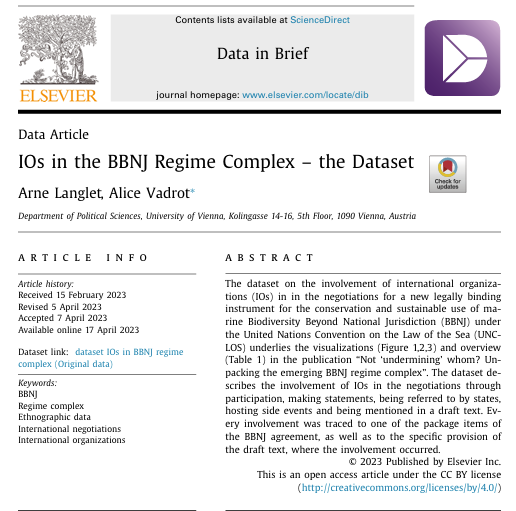
The dataset on the involvement of international organizations (IOs) in in the negotiations for a new legally binding instrument for the conservation and sustainable use of marine Biodiversity Beyond National Jurisdiction (BBNJ) under the United Nations Convention on the Law of the Sea (UNCLOS) underlies the visualizations and overview in the publication “Not ‘undermining’ whom? Unpacking the emerging BBNJ regime complex”. The dataset describes the involvement of IOs in the negotiations through participation, making statements, being referred to by states, hosting side events and being mentioned in a draft text. Every involvement was traced to one of the package items of the BBNJ agreement, as well as to the specific provision of the draft text, where the involvement occurred.