
Portugal’s geographic position and its history as a sea crossing nation are deeply ingrained in the country’s history and in its policy preferences. How is this reflected in Portugal’s behaviour in negotiations surrounding the International Seabed Authority (ISA)? Our intern Sérgio Luz is taking a closer look.
Written by Sérgio Luz
Sérgio Luz is a Master’s student in History, International Relations and Cooperation at the University of Porto. He joined the EPRG from February to April 2026 as an intern and guest researcher. His tasks included data collection at the 31st session of the International Seabed Authority’s negotiations, which inspired the following blog post.
Portugal is a small country located at the west end of continental Europe, bordering only Spain and with a population of around 10 million people. Nevertheless, it is worth understanding that Portugal possesses a significantly big Exclusive Economic Zone (EEZ) that is expanded further by its archipelagos of Madeira and Azores in the Atlantic Ocean. As such, Portugal can be geographically viewed through two lenses: its land territory and its EEZ. Given the vast area of ocean covered by its EEZ, at first glance one could assume that Portugal could have much to gain from deep-sea mining and that it would therefore support the accelerated development of the mining code within the International Seabed Authority (ISA). However, this does not seem to be the case. In fact, Portugal has joined the group of countries advocating for a moratorium in the ISA, and on a national level it went so far as to ban deep-sea mining in its own waters until 1 January 2050. This not only shows a strong commitment to environmental conservation, but may also serve as a key indicator of what Portugal represents as a state. Therefore, Portugal’s perspective on this issue, as well as its view of the world and itself, can be further analysed through the constructivist theory of international relations that I will proceed to do in this blog post.
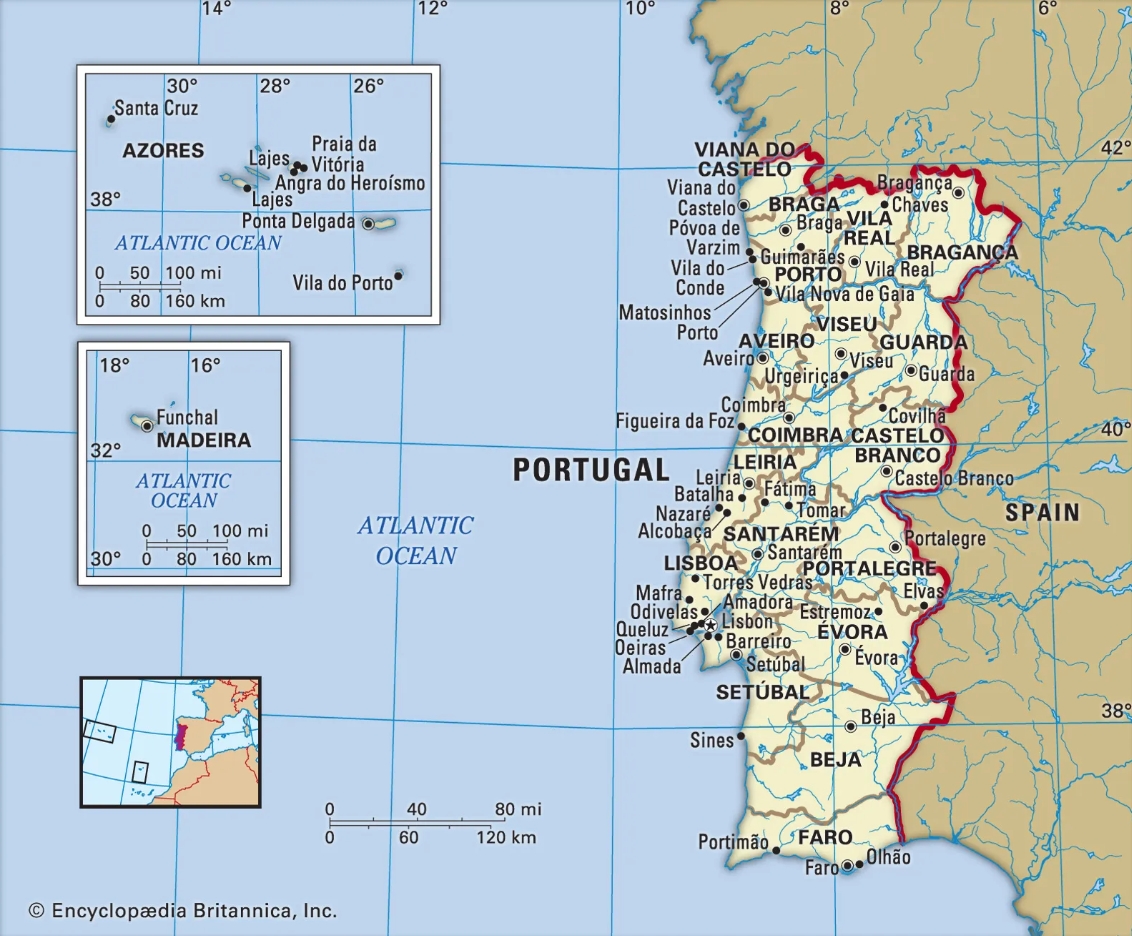
Image 1: Portugal’s land borders; Source: https://www.britannica.com/place/Portugal

Image 2: Portugal’s EEZ map; Source: Source: https://www.portugalresident.com/portugal-is-95-water/
This blog post will therefore explore what is known about Portugal’s history, how constructivist theory applies to it, and how it can be used as a lens to better understand Portugal’s position in the current ISA debate. But first we need to explore the origins of this nation and in what way does it portray itself, meaning, how does Portugal define itself and what are the vital parts to understand its identity. That way, it may help further understand Portugal’s choice to advocate for the moratorium in the ISA.
What is Portugal and what defines it?
It is hard to think of Portugal without considering its status as a member of the European Union since 1986. But it is important to note that Portugal is, in fact, one of the oldest nation-states in Europe, with stable borders and nearly 900 years of history. Before Portugal came into existence, the Iberian Peninsula witnessed a wide variety of peoples either settling or passing through it. Among these were the Romans, Visigoths, Suebi, Arabs and Berbers, each leaving a lasting mark on the region. Of all these groups, the Romans may be the most notable, particularly because the Portuguese language descends from Latin, and several Roman structures can still be found across the country. The Romans did not have much use for the western part of the Iberian Peninsula that today makes up Portugal, in fact they considered it to be the end of the world due to its position facing the Atlantic Ocean. However, if we fast forward to the 14th Century, a period during which Portugal was already recognised as a State and political entity, we will find that the Portuguese economy relied heavily on maritime resources. These included shellfish from the river mouths, as well as tuna, sharks, sardines and hake from ocean fishing. Lisbon also developed into an important international trading hub, serving as a safe harbour for merchants from places such as Genoa, Venice, England, and other northern European regions. The sea would soon become central to Portugal’s place in history, particularly for when its golden age was on full display in the 15th and 16th centuries.

Image 3: Painting of the Portuguese sailors triumphing over the Cape of Good Hope and the Giant Adamastor; Source: https://www.leme.pt/magazine/efemerides/1122/vasco-da-gama-dobra-cabo-da-boa-esperanca.html
During that period, Portugal established sea routes to overseas territories such as today’s Brazil, Southeast Asia and even reaching as far as Japan. This enabled Portugal become the main commercial intermediary between Europe and Asia through means of maritime navigation. Even during the 20th century “Estado Novo” period of Portuguese history, it was remarkable how much the State clung to its overseas territories that were accessible only through the ocean. Given these historical developments, it is reasonable to conclude that the ocean has played a vital role in Portuguese history and how the nation developed throughout the years.
Through the constructivist lens, we can understand how actors create their vision of themselves through processes of interaction, how they influence their environment, as well as how they are influenced by it. This can be observed not only in how Portugal interacted with and influenced other states, but also in the way these states interacted with Portugal, namely, through the sea. It is also important to note that the existence of state interests cannot be denied, however, these interests are closely tied to the identity of states. In Portugal’s case, the aim was to reach India via ocean routes, therefore, the ocean became a central driving force in shaping Portuguese identity. This can be seen as a clear example of mutual constitution. That is also reflected in Portuguese culture, folklore and literature, as seen in works such as A Carta by Fernando Pessoa and Os Lusíadas by Luís Vaz de Camões. Both play a major role in defining an “us” for the Portuguese, and the latter further reinforces the idea of a challenge or a “other” (the ocean) that must be overcome by “us” (the Portuguese), which shows that the theory of mutual constitution may also apply to geography. To this day this “us”, which developed throughout Portuguese history as a people who faced the adversities of the sea, can be further understood through the Weberian concept of Verstehen, which refers to a collective interpretation, practices and institutions of actors. The ocean, therefore, constitutes an essential part for the construction of the Portuguese identity and has served as a key vehicle for prosperity throughout its history.
Reflection in today’s politics
That same importance can even be seen in Portugal’s politics over the last few years. In March 2023, an open letter calling for Portugal to join the moratorium in the ISA was issued by WWF Portugal to the Portuguese government, at the time led by the centre-left Socialist Party (PS). The Minister for the Economy and Ocean at that time, António Costa e Silva defended that a precautionary pause is needed until there is further clarification on the regulations and more advanced research regarding the environmental impacts. Following that, during the 28th Session of the International Seabed Authority, Portugal joined the moratorium on deep-sea mining. This position demonstrates that there was political will within the government to commit to a precautionary pause until there was more data available on the impacts that deep-sea mining may cause on the ocean. However, the Socialist Party rule as Portugal’s 23rd Constitutional Government ended abruptly when its Prime Minister António Costa, resigned after a political scandal, and the then President of Portugal, Marcelo Rebelo de Sousa, called for new elections. When a new government was established, led by a coalition between the conservative CDS-PP and the centre-right Social-Democratic Party (PSD) in 2025, Portugal did not change its stance within the ISA. In fact, it went as far as banning deep-sea mining within its national waters until 1 January 2050. One could observe that, regardless of the political shift within Portugal, its position on deep-sea mining remains firmly aligned with the moratorium within the ISA and the preservation of its national waters from seabed mining activities.
Portugal’s presence in the ISA
It is important to understand the why these negotiations matter overall. In today’s globalized world where international law is developing and adapting to an everchanging world, establishing the means of dialogue is crucial for diplomacy to work in a transparent way. This dialogue comes in the form of negotiations inside structures such as de ISA that should stand as a symbol for diplomacy through transparency. Transparency, however, does not only come with showing up and share one’s opinion and stance, but also through sharing knowledge that could, for example, in the form of data.
It is during these negotiations where delegations from both state, and non-state actors, pursue their interests and make their agenda noticeable in a restrained setting. By observing these negotiations, we can analyse everything, from the language used, what topics the delegations choose to intervene in, with who they agree or disagree, and last but not least, their opening statement and use of rhetoric to make their stance known. This is part of why negotiation processes may be important, not just their outcome. During negotiations, Portugal does not show a relatively large number of statements or interventions, however it is observable through some of these statements their stance on both seabed mining and their commitment for the preservations of the sea.

Image 4: Portugal’s statements per session during the 30th Session of the International Seabed Authority
During the 30th Session of the International Seabed Authority, on 17 March of 2025, the Portuguese delegation issued an opening statement reinforcing their position and view:
“A clear and transparent framework for benefit sharing must be at the core of any decision on the future of seabed mining, for an environmental perspective, we must carefully consider the impacts of such activities on the marine environment. […] Equally important is to clearly assure that exportation activities will benefit humankind and assure humankind that it will not cause harmful effects to the marine environment.”

Image 5: Maria Mendes, 2025; Source: https://enb.iisd.org/international-seabed-authority-isa-council-30-2-7july2025
This opening statement shows that Portugal’s vision clearly aligns with the principle of conserving the marine environment, which is further reinforced by the fact that it has banned deep-sea mining within its EEZ, on which the country’s economy also relies.
Where do we go from here?
Portugal’s stance over the years seems not to waver from showing appreciation for the ISA as an institution, its commitment to contributing to the ISA’s mandate, follow international law, ensure that the activities carried should benefit all of humankind and last, but not least, make sure that the same activities do not cause any dangers to the marine environment. The latter seems to just further add to the way that Portugal sees the Sea, which was once it’s greatest challenge and obstacle to overcome, is now something that must be preserved and protected. There is no doubt that the ocean is important to Portugal in various aspects that we have seen through this blog post, and as such, its commission should continue to have an active role within the ISA meetings.

Image 6: Maria Mendes in the negotiations room, 2026; Source: https://enb.iisd.org/international-seabed-authority-isa-council-31-1-16Mar2026
For further information on the ISA, please consider reading the report by our researcher Emil W. Hildebrand on the 30th Session of the International Seabed Authority
Sources:
Captivating History. (2022). History of Portugal: a Captivating Guide to Portuguese History from Ancient Times to the Present.
Dias, S. S. (2023, July 17). Portugal vota contra mineração em mar profundo. Jornaldenegocios.pt; Jornal de Negócios. https://www.jornaldenegocios.pt/sustentabilidade/ambiental/detalhe/portugal-vota-contra-mineracao-em-mar-profundo
Dunne, T., Kurki, M., & Smith, S. (2013). International Relations Theories: Discipline and Diversity. Oxford University Press, Cop.
Geraldes, H. (2025, March 14). Parlamento português aprova moratória à mineração em mar profundo – Wilder. Wilder. https://wilder.pt/historias/parlamento-portugues-aprova-moratoria-a-mineracao-em-mar-profundo
Moreno Barreneche, S. . (2023). O mar e a viagem marítima na construção discursiva da identidade nacional portuguesa. Análise Social, 59(252), e202135. https://doi.org/10.31447/202135 (Original work published 23 de abril de 2024)
Steinberg, P. (2001). The social construction of the ocean. Cambridge University Press.
Vadrot, A. B. M. (2020). Multilateralism as a ‘site’ of struggle over environmental knowledge: the North-South divide. Critical Policy Studies, 14(2), 233–245. https://doi.org/10.1080/19460171.2020.1768131


